
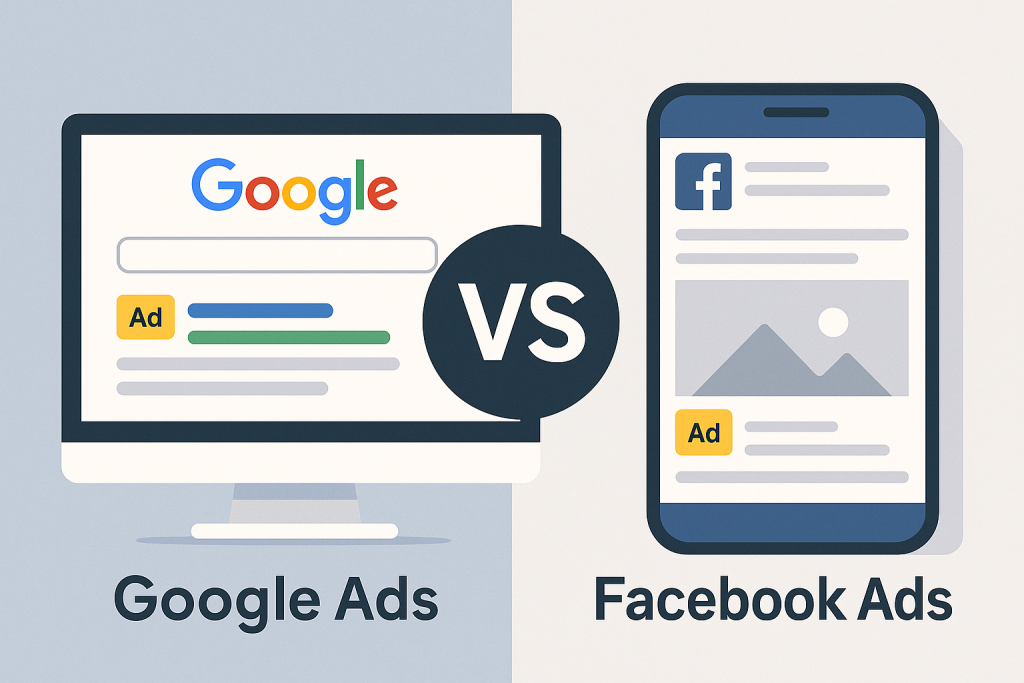
In the world of digital marketing, two advertising giants continue to dominate: Google Ads and Facebook Ads (Meta Ads).
Both platforms can bring incredible results — but they work in completely different ways.
Choosing the right one depends on your business goals, your audience, your budget, and even the stage of your marketing funnel.
Below is a practical, up-to-date comparison of the strengths and weaknesses of each platform, so you can choose the best strategy for your campaigns.
1. Google Ads: The Power of Search Intent
Google Ads is built around intent-based advertising.
People come to Google when they actively search for a solution:
“Buy running shoes,” “Book hotel in Dubai,” “Best SaaS tools,” “VPN for Turkey.”
This means the user is already interested — and often ready to buy.
✅ Google Ads – Advantages (Pluses)
1. High-intent traffic
Users are searching for what you sell → higher chance of conversion.
2. Massive reach
Google Search, Display Network, YouTube, Gmail — billions of daily impressions.
3. Better for direct sales
Ideal for e-commerce, services, SaaS, and local businesses.
4. Strong analytics and tracking
Conversion tracking, offline imports, enhanced attribution, search term insights.
5. Works incredibly well for retargeting
Display + YouTube remarketing = strong closing power.
6. Google Shopping dominates e-commerce
If you sell products, Google Shopping ads often outperform everything else.
❌ Google Ads – Disadvantages (Minuses)
1. High cost-per-click (CPC) in competitive industries
Finance, travel, legal, IT, and SaaS can be extremely expensive.
2. Requires strong landing pages
If your landing page is weak, your results fail no matter how good your ads are.
3. Limited creative freedom
Mostly text-based (Search) or standard banners (Display).
4. Harder for new brands
If nobody searches for your brand yet, Google doesn’t create demand — it captures demand.
5. Learning curve
Beginners struggle with keyword match types, bidding, Quality Score, and complex settings.
2. Facebook Ads (Meta Ads): The Power of Audience Targeting
Facebook and Instagram are built around interest-based and behavior-based advertising.
People are not searching — they are scrolling.
Your job is to grab attention and create demand, even if the user wasn’t planning to buy.
✅ Facebook Ads – Advantages (Pluses)
1. Best platform for building awareness
Perfect for introducing your brand to new audiences.
2. Advanced targeting options
Interests
Behaviors
Demographics
Lookalikes
Custom audiences
Pixel data
Very powerful for audience building.
3. Visual and storytelling-friendly
Videos, carousels, lifestyle content → perfect for emotional persuasion.
4. Cheaper CPM + low-cost reach
You can reach thousands of people for a small budget.
5. Great for mobile conversions
Instagram & Facebook dominate mobile use.
6. Ideal for creative testing
Tons of ad formats and rapid A/B testing opportunities.
❌ Facebook Ads – Disadvantages (Minuses)
1. Lower purchase intent
People aren’t searching to buy → lower conversion rate for some industries.
2. Difficult after iOS privacy updates
Tracking and targeting weakened (especially for small budgets).
3. Creative burnout
Ads stop performing fast → continuous content creation required.
4. Sensitive niches may get restricted
VPN, crypto, finance, health, and supplements face policy limitations.
5. Unstable performance
Algorithm changes can quickly shift costs or break previously successful campaigns.
3. Google Ads vs Facebook Ads: Which One Should You Choose?
Here is a practical summary:
Choose Google Ads if you want:
- high-intent buyers
- immediate sales
- measurable ROI
- strong B2B or local leads
- e-commerce customers ready to purchase
- people searching for your keywords
Perfect for:
E-commerce, SaaS, services, hotels, clinics, real estate, local businesses.
Choose Facebook Ads if you want:
- brand awareness
- new audience growth
- cold traffic generation
- creative-based selling
- storytelling and video engagement
- community building
Perfect for:
Fashion, beauty, fitness, education, apps, influencers, lifestyle products, subscriptions.
4. The Best Strategy in 2024–2025: Combine Both
Today’s top-performing brands don’t choose between Facebook and Google — they combine both.
Here’s why:
Facebook creates demand.
You show your product to people who didn’t know they needed it.
Google captures intent.
People search for your solution after seeing your Facebook ad.
Together, they create a complete funnel:
- Facebook Ads → Awareness + Engagement
- Google Ads → Conversions + Retargeting
- YouTube Ads → Brand trust
- Remarketing across both → Higher ROI
This blended approach consistently outperforms using only one platform.
Final Thoughts
Both Google Ads and Facebook Ads are extremely powerful — but they work differently.
If your business needs fast sales from high-intent users, Google Ads wins.
If you need attention, brand awareness, and creative storytelling, Facebook Ads wins.
The smartest marketers use both to create a strong, scalable, and profitable advertising ecosystem.
Leave a Reply